
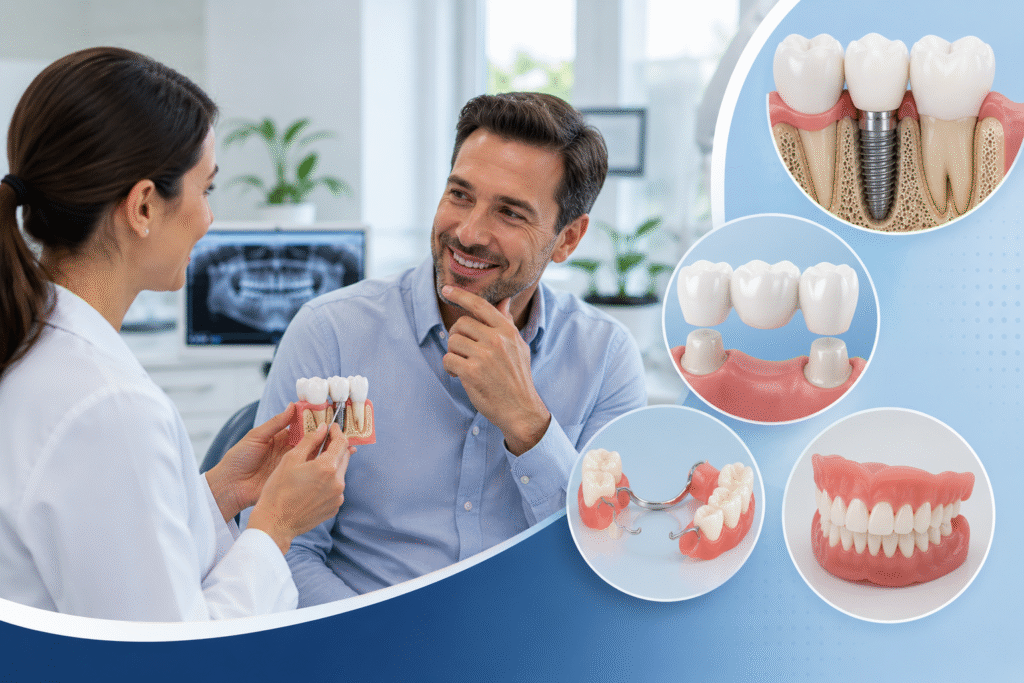
Dentists most commonly recommend dental implants, bridges, and dentures as the top tooth replacement options.
Modern dentistry offers more tooth replacement options than ever before, each with distinct advantages depending on your oral health, lifestyle, and budget. The challenge is knowing which solution is right for you.
This guide breaks down the four main tooth replacement options that Holly Springs dentist recommend: dental implants, dental bridges, complete dentures, and partial dentures.
You’ll get a clear picture of how each one works, what it costs, how long it lasts, and who each option suits best.
By the end, you’ll be well-equipped to have an informed conversation with your dentist about reclaiming your smile.
Understanding Your Tooth Replacement Options: A Comprehensive Overview
Before diving into the details, it helps to understand what’s available at a high level.
- Dental implants are surgically placed titanium posts that permanently fuse with the jawbone, acting as artificial tooth roots. A crown is then attached on top.
- Dental bridges are fixed prosthetics anchored to adjacent natural teeth, literally “bridging” the gap left by a missing tooth.
- Complete dentures are removable appliances used when all teeth in the upper or lower arch are missing.
- Partial dentures are removable appliances designed for patients with several missing teeth spread across the arch, where some natural teeth remain.
Each option has a different cost profile, recovery timeline, and long-term maintenance requirement.
Choosing the right one depends on your specific dental situation, which is why professional consultation with a Dentist Fuquay Varina is essential.
Dental Implants: The Gold Standard for Tooth Replacement
How do dental implants work?
A dental implant consists of three components: a titanium post (the implant itself), an abutment, and a dental crown. During the procedure, an oral surgeon or periodontist places the titanium post directly into the jawbone.
Over the following three to six months, the bone fuses with the post through a process called osseointegration. Once that’s complete, the abutment and crown are attached to complete the restoration.
What are the advantages of dental implants?
Implants are widely regarded as the closest thing to a natural tooth. Key advantages include:
- Durability: With proper care, implants can last 25 years or more—potentially a lifetime.
- Bone preservation: The titanium post stimulates the jawbone the same way a natural tooth root does, preventing the bone loss that occurs with other replacement options.
- Natural appearance and function: Implant-supported crowns are virtually indistinguishable from natural teeth and allow normal chewing and speaking.
- No impact on adjacent teeth: Unlike bridges, implants don’t require the modification of neighboring teeth.
Who is the best candidate for dental implants?
Implants are best suited for adults with sufficient jawbone density to support the post, healthy gums, and no uncontrolled systemic conditions like unmanaged diabetes.
Patients who smoke or have significant bone loss may require bone grafting before implant placement. Age is also a consideration; implants are generally not recommended for adolescents whose jawbones are still developing.
Dental Bridges: A Proven Alternative for Fixed Tooth Replacement
How are dental bridges constructed?
A traditional dental bridge consists of two dental crowns placed on the teeth adjacent to the gap (called abutment teeth) with one or more artificial teeth (pontics) suspended between them. The bridge is cemented in place and is not removable.
Other types include cantilever bridges (anchored on one side only) and Maryland bridges (bonded with a metal or porcelain framework to the backs of adjacent teeth).
What are the advantages of choosing a dental bridge?
Bridges offer several practical benefits:
- Faster treatment timeline: The process typically takes two to three dental visits over a few weeks, compared to the months-long process for implants.
- Lower upfront cost: Bridges generally cost between $1,500 and $3,500, making them a more accessible fixed option.
- No surgery required: Bridges don’t involve any surgical placement, which makes them suitable for patients who can’t undergo surgery.
- Insurance coverage: Dental insurance is more likely to contribute toward a bridge than an implant.
What are the limitations of dental bridges?
The primary drawback of a traditional bridge is that it requires grinding down the two adjacent healthy teeth to serve as anchors.
This permanently alters those teeth and can increase their vulnerability over time.
Bridges also don’t prevent bone loss at the site of the missing tooth, since there’s no root stimulating the jawbone.
Most bridges last 10 to 15 years before needing replacement, depending on oral hygiene and wear.
Bridges work best when the adjacent teeth are strong and healthy, and when the patient is looking for a fixed solution without the commitment of surgery.
Dentures: Accessible and Flexible Tooth Replacement
What’s the difference between complete and partial dentures?
Complete dentures replace all teeth in the upper or lower arch and rest directly on the gum tissue. Partial dentures, by contrast, fill in gaps where several teeth are missing, attaching to remaining natural teeth with metal clasps or precision attachments.
Both types are removable and can be taken out for cleaning.
What are the advantages of dentures?
Dentures remain one of the most accessible tooth replacement options available:
- Non-invasive: No surgery required.
- Adjustable: Dentures can be modified or relined over time as the mouth changes.
- Affordable: The most cost-effective option for full-arch replacement.
- Fast turnaround: Dentures can often be fabricated within a few weeks.
What challenges come with wearing dentures?
Dentures come with a real adjustment period. New wearers often experience difficulty speaking and eating, increased saliva production, and sore spots as the gums adapt. Poorly fitted dentures can slip, cause discomfort, and affect confidence in social situations.
A significant long-term concern is bone resorption. Without tooth roots stimulating the jawbone, the bone gradually shrinks over time, causing the face to take on a “sunken” appearance and requiring periodic relining or replacement of the denture to maintain fit.
Modern denture technology has improved considerably.
High-quality acrylic materials, implant-supported overdentures, and better adhesives have made today’s dentures more comfortable and natural-looking than previous generations.
Tips for adapting to denture wear
- Remove and clean dentures after every meal.
- Soak dentures overnight to maintain their shape.
- Schedule regular dental checkups to monitor fit and bone health.
- Start with softer foods and gradually reintroduce a normal diet.
- Consider implant-retained dentures for improved stability if bone density allows.
Comparing Cost, Durability, and Maintenance Across All Options
| Option | Average Cost | Expected Lifespan | Daily Maintenance |
| Dental Implants | $3,000–$7,000 per tooth | 25+ years | Brush, floss, regular checkups |
| Dental Bridges | $2,500–$4,500 | 10–15 years | Floss under bridge, regular checkups |
| Complete Dentures | $1,200 to $3,500 per arch, $2,400 to $7,000 for a full set | 5–10 years | Remove, clean daily, overnight soaking |
| Partial Dentures | $700–$2,500 | 5–15 years | Remove, clean daily, check clasps |
What Dentists Recommend: Key Factors in Choosing a Solution
What factors do dentists consider when recommending a tooth replacement option?
A qualified dentist evaluates several patient-specific factors before making a recommendation:
- Bone density and volume: Sufficient bone is required for implant placement. Patients with significant bone loss may need grafting or may be better suited for bridges or dentures.
- Number and location of missing teeth: A single missing tooth is often best replaced with an implant; multiple missing teeth may call for a bridge, partial denture, or full denture.
- Overall oral health: Active gum disease or decay must be treated before any restorative work begins.
- Age and systemic health: Certain medical conditions and medications can affect healing and implant success rates.
- Lifestyle and preferences: Patients who prioritize convenience may prefer a fixed option; those seeking the most affordable solution may opt for dentures.
Dental implants have a success rate of approximately 95% over 10 years when placed in appropriate candidates. This makes them the most evidence-backed long-term solution currently available.
In clinical practice, many dentists note that patients who invest in implants early, before significant bone loss occurs, achieve the best outcomes and avoid the cascading dental problems that missing teeth can cause.
Replace Missing Teeth Sooner Rather Than Later
Missing teeth are rarely just a cosmetic issue. Left untreated, a single missing tooth can trigger bone loss, shift adjacent teeth, and create bite problems that affect the entire mouth. The longer the delay, the more complex and costly the fix becomes.
Dental implants offer the most durable, functional, and aesthetically natural solution for most patients. Bridges provide a solid fixed alternative when surgery isn’t an option or when speed and cost are priorities. Dentures remain the most accessible path to full-arch restoration, especially for patients with extensive tooth loss or complex medical histories.
There’s no single “best” option for everyone, only the best option for your specific situation.
Ready to take the next step? The team at Novel Dental is here to help you explore your tooth replacement options with confidence.
Our experienced Holly Springs dentist team combines clinical expertise with personalized care to find the solution that fits your smile, your health, and your life.
Schedule your consultation with Novel Dental today and start the journey toward a complete, healthy smile.
Frequently Asked Questions About Tooth Replacement Options
What is the most recommended tooth replacement option by dentists?
Dental implants are most commonly recommended by dentists as the gold standard for tooth replacement. Implants have a success rate of approximately 95% over 10 years. They preserve bone, restore full chewing function, and closely replicate the look and feel of natural teeth.
How long does it take to get a dental implant from start to finish?
The full dental implant process typically takes three to six months from surgical placement to final crown attachment. Most of this time is spent waiting for osseointegration, the process by which the titanium post fuses with the jawbone. Patients who require bone grafting before implant placement may need additional time.
Are dental bridges better than implants for replacing a single missing tooth?
Dental implants are generally preferred over bridges for single-tooth replacement because they don’t require altering adjacent teeth, and they preserve jawbone density. However, a dental bridge may be the better choice if the adjacent teeth already have significant restorations, if surgery is not an option, or if a faster, lower-cost solution is needed.
Can you get dental implants if you have bone loss in your jaw?
Yes, in many cases. Patients with moderate bone loss may be candidates for bone grafting before implant placement. However, the extent of bone loss and overall oral health will determine whether grafting is viable. Your dentist or oral surgeon can assess your bone density using X-rays or a CT scan.
What happens if you don’t replace a missing tooth?
Leaving a missing tooth untreated can lead to jawbone deterioration at the site of the missing root, shifting of adjacent teeth, bite misalignment, increased risk of gum disease, and changes to facial structure over time. Dentists generally recommend replacing missing teeth as promptly as possible to prevent these complications.